
US Ancestry: 2000

by Catherine Mulbrandon

in Maps

“The Census Bureau defines ancestry as a person’s ethnic origin, heritage, descent, or roots, which may reflect their place of birth, place of birth of parents or ancestors, and ethnic identities that have evolved within the United States.” from a Census brief on US ancestry. The map below displays the ancestry with the largest population in each county. However, they may not be a majority (>50%) of the population.

{Click on the image to take a closer look}
US Population Ancestry magnifying glass

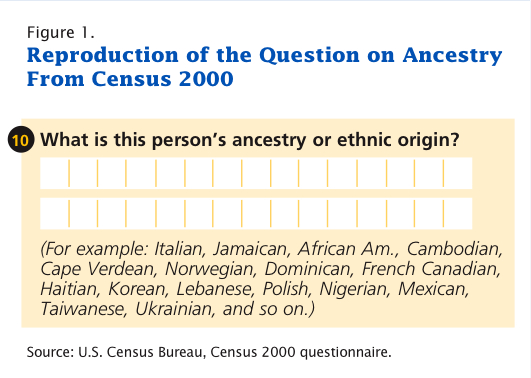
Below is the question that was presented on the long form of the US Census. “In 2000, 58 percent of the population specified only one ancestry, 22 percent provided two ancestries, and 1 percent reported an unclassifiable ancestry such a mixture or adopted. Another 19 percent did not report any ancestry at all.”

{Click on the image to take a closer look}
US Population Ancestry magnifying glass

[tags]United States, Population[/tags]

Post Revisions:

There are no revisions for this post.

  • Daniel Drucker

    “Seven percent of the U.S. population reported their ancestry as American. The number who reported American and no other ancestry increased from 12.4 million in 1990 to 20.2 million in 2000, the largest numerical growth of any group during the 1990s.5 This fig- ure represents an increase of 63 percent, as the proportion rose from 5.0 percent to 7.2 percent of the population.”

    What does “American” mean? Just that the ancestors moved to North America long enough ago that nobody knows where they came from?

  • yawn your story is old and tired

    yeah, i mean, what the hell is “american”?

    native americans are “american.” this is an insult to them.

    i can only imagine they chose “american” because there was no option for “white.”

  • Singh

    Amazing!

    American is anybody who doenst know or doesnt care where there ancestors came from and Yawn is a bigot.

  • lakelady

    Exactly how long does one have to live in a country before you consider your ancestry to be of that country? Clearly an undefined variable. For example my ancestry is a mix of mostly Dutch and English so I could list that. But my ancestors have been here for over 300 years. At what point do I get to call my ancestry “American”. I would probably choose either mixed or American for a survey like this. That doesn’t mean that I don’t know anything about my ancestry. Again a false assumption.

    This is a great example of how misleading maps and statistics can be when poorly implemented.

  • tacitus

    “This is a great example of how misleading maps and statistics can be when poorly implemented.”

    Actually, this map is wonderful picture of the way people describe themselves, and by that token they way they conceive of their identities.The map does not mislead as long as you keep in mind that people’s self-reporting is not the same thing as a genetic test.

    I think it’s fascinating to see that so much of the South basically thinks of itself as American, whereas the rest of the country identifies with various “legitimate” ancestries. And then that the other big chunk of people in the South choose/are African-American- it gives a interesting picture of what that place is like, regardless of how accurately it represents the true “ethic” make-up of the place.

    Wouldn’t it be interesting to try to correlate this map to the classic Red/Blue electoral maps that we’ve all seen? I bet it’s been done somewhere. Overall, great stuff here.

  • Pingback: U.S. Ancestry Map from the Census Bureau | The Blog of Record

  • Indiana John

    A wonderful map.
    Who we are in our own words.
    Anywho we think we are, anyhow.

  • Allegra Manzoni

    I think that part of the increase in the number of persons identifying as ‘American’ has to do with the proliferation of the internet as a tool for genealogical research: As more people are exploring their ancestry on the ‘net, more of them are finding that they have multiple origins, both before and after emigrating to this continent.

Previous post:

Next post: