
Has Middle America’s Wages Stagnated?

by Catherine Mulbrandon

in Growth of Income Inequality, VE Infographics

{Click on the image to take a closer look}
Avg Hourly Earnings magnafing glass

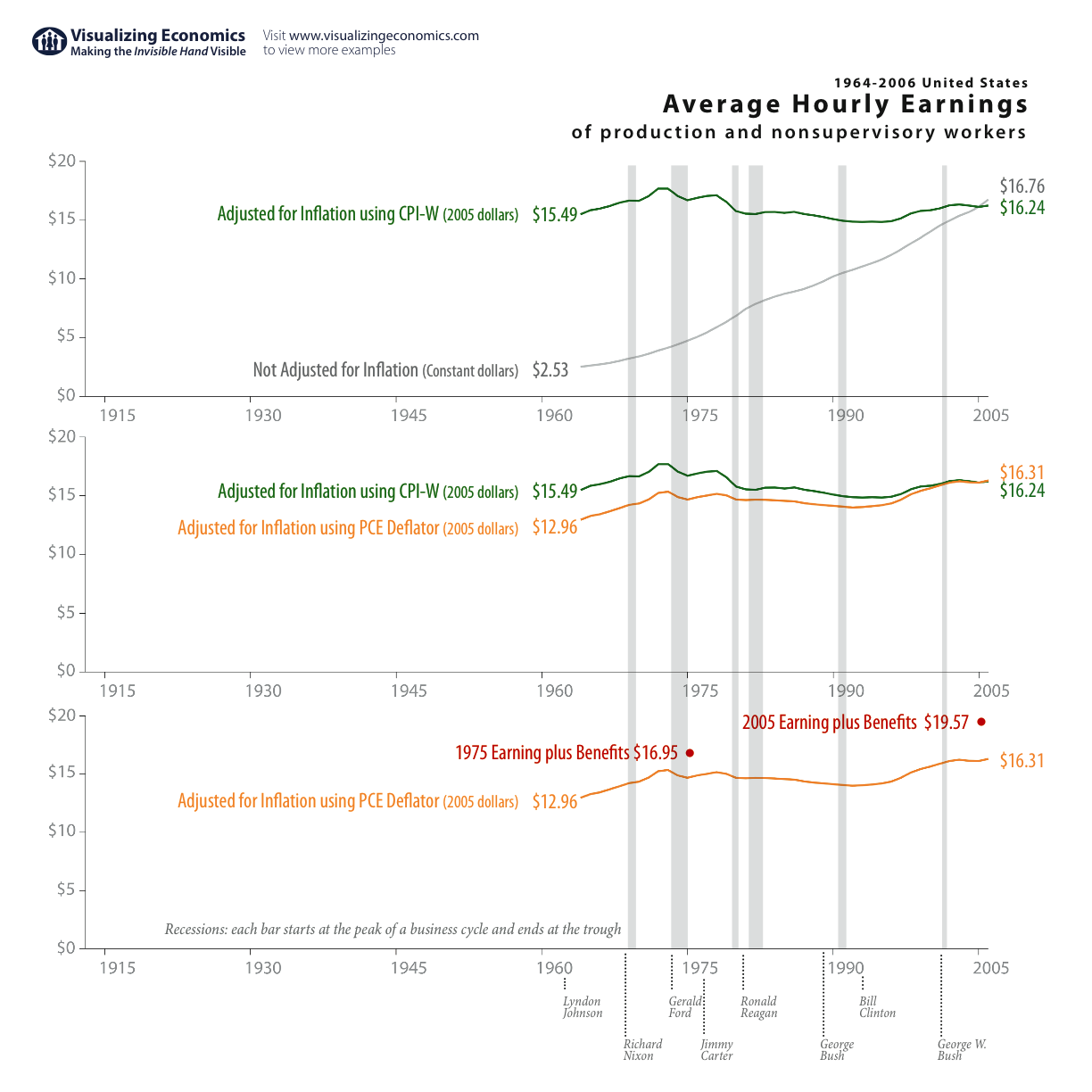
I found a Federal Reserve article that analyzed the change in Average Hourly Earnings for production and nonsupervisory workers. After adjusting for inflation using the Personal consumption expenditures (PCE) {instead of the Consumer Price Index-Urban Wage Earners and Clerical Workers (CPI-W)} and including an estimate for worker’s benefits, the author concluded that workers’ hourly earnings (wages plus benefits) actually increased by 16% over 30 years (1975-2005) rather than decreased. Here, I graphed the full history, 1964-2006, but used the approach laid out in the article to show the effect of inflation and benefits. BTW, if you earned $16.76 an hour in 2006 that gave you an annual income of $33,520 (assuming you worked full-time).

See also:
Average Income in the United States
Total Income of Top, Middle, & Bottom

[tags]income distribution, income inequality, Federal Reserve, wages, middle class[/tags]

Addendum: This was past on to me from a reader who found it on Marginal Revolution

Post Revisions:

There are no revisions for this post.

  • http://flowingdata.com Nathan

    I’m guessing each of the three graphs represent a group of workers, but what groups? Pretty though.

  • Michael

    Oddly, with the exception of the last graph those trends look pretty flat to me. Still, I’ll grant a 16% increase in buying power over the last thirty years. What’s the chart look like for productivity and overall profits? Is that also 16%? Are the people responsible for the alleged explosion in productivity and profit sharing in the fruits of their labor?

  • Catherine

    The wages are for production and nonsupervisory workers and represents maybe 80 percent of nonfarm wage and salary employees. It is not a perfect measure but it can give some clue as to the trend of wages over time.

  • Maureen Perry

    I would be interested in seeing the average income in US leaving out the top 5% which seems to me skews the numbers

  • http://team651.org John Blickenstaff

    You should include the period before that if at all possible. I would like to see the effect of Taft-Hartley.

  • Pingback: W poszukiwaniu źródeł kryzysu | nowe peryferie

Previous post:

Next post: